
Lenovo Legion Go S Retail Mini-Game Case Study: When the Game Becomes the Product Demo
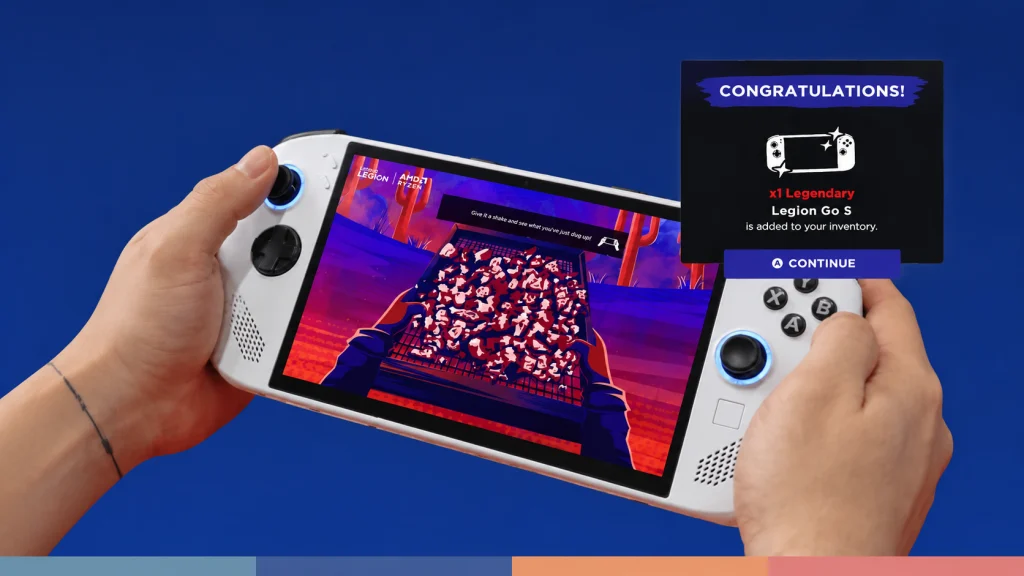
- The Lenovo Legion Go S has three control innovations (gyro, touch, tilt) that do not translate to a spec sheet on a retail shelf.
- Level Up powered by Agate built a retail mini-game in which every mechanic maps to one of those hardware capabilities.
- Gyro steering tests motion tracking, touch swipe tests rapid input, and tilt-based selection tests spatial control without buttons.
- The format is designed for a 90-second in-store session with a zero learning curve, so walk-in customers can engage immediately.
- This format works best for products where differentiation is sensory, such as haptics, button feel, motion control, or screen response.
The handheld gaming category has a retail-floor problem. Every device on the shelf looks similar in its box. Specs differentiate, but specs do not translate into the 90-second decision that a walk-in customer actually makes.
The Lenovo Legion Go S has three control innovations: gyro motion tracking, rapid touch input, and tilt-based spatial selection. None of those land via a spec sheet. They land when the customer’s hands learn what the device can do. This case study describes how Level Up powered by Agate solved that retail problem by turning the demo into a game.
The Retail Problem in One Line
A box on a shelf cannot show you what gyro feels like.
This is the core problem for any product whose advantage is sensory. The spec sheet is read by buyers who already know they want the product. Walk-in customers usually decide based on what they can experience in the first 90 seconds at the display, and a sensory advantage that is never experienced is functionally invisible.
The Design Brief
The team set four design constraints for the activation, each tied directly to the retail context.
- A mini-game that is playable on the demo unit, not on a separate device.
- Zero learning curve, with a 90-second floor session that any walk-in customer can complete.
- Every game mechanic maps to a specific hardware capability of the device.
- The ‘demo experience’ and the ‘feature explanation’ become the same thing, so the customer does not need a salesperson narrating the spec sheet.
Mechanic-to-Capability Mapping
The most important design decision was the explicit mapping between game mechanics and hardware capabilities. Each mechanic in the game was selected because it could only be played well using a specific feature of the Legion Go S.
Gyro Steering Maps to Motion Tracking
The steering mechanic uses small wrist motion rather than a thumbstick. The customer’s hands learn that the device tracks fine motion accurately, without anyone needing to explain that the gyroscope is the differentiator. The hardware feature becomes a felt capability rather than a bullet point.
Touch Swipe Maps to Rapid Input
The swipe mechanic relies on the screen reading rapid input directly, with no controller layer. The customer learns that the screen is responsive at speed, which is what the device’s touch capability actually provides. The mechanic cannot be played well on a device with slower screen response, which makes the demo a real differentiation test.
Tilt Selection Maps to Spatial Control
The selection mechanic uses tilt-based input that works regardless of how the device is held. The customer experiences spatial control without buttons, which is the practical benefit of tilt-based selection. The mechanic also makes the device feel comfortable in any orientation, which becomes a sensory memory tied to the brand.
Side-by-Side: Traditional Retail Demo vs Game-Based Retail Demo
|
Dimension
|
Traditional Retail Demo
|
Game-Based Retail Demo
|
|---|---|---|
|
Format
|
Salesperson explains specs
|
|
|
Cognitive load
|
Customer parses technical claims
|
Customer learns through motion and play
|
|
Behavioral memory
|
Low, the spec sheet fades quickly
|
High, motor memory is durable
|
|
Time to engage
|
Depends on salesperson availability
|
Walk-up and play, no staff dependency
|
|
Feature visibility
|
Stated but not felt
|
Felt directly through gameplay
|
|
Brand association
|
Mostly logo and packaging
|
Brand tied to a sensory experience
|
Table 1. Side-by-side comparison of a traditional retail demo and a game-based retail demo, based on the Lenovo Legion Go S activation built by Level Up powered by Agate.
Why the Format Works
The mechanism behind this format is simple. Traditional retail demo creates a moment in which the salesperson explains a spec, the customer nods, and the customer walks away with limited behavioral memory of the device. A game demo creates a moment in which the customer’s body learns the input. Motor memory is denser than memory of marketing copy, and the product becomes physically associated with the brand in the customer’s mind.
Lenovo’s published case write-up frames the outcome qualitatively, focusing on engagement time at the display, product memorability, and perception of innovation. The specific numbers behind retail-activation lift are typically reported privately between agency and client. The publishable part is the design principle, and the design principle is reusable across the category.
Where This Format Fits Best
The retail mini-game format is most useful when a product’s differentiation is sensory rather than purely functional. Categories where this fits include the following.
- Handheld devices with haptic feedback, motion control, or screen response that does not appear on a spec sheet.
- Audio products where the differentiator is feel, frequency response, or noise cancellation.
- Smart home and wearable products where the value is the moment-to-moment interaction.
- Automotive showroom experiences for features like driver assist, gesture control, or steering response.
- Any product where the salesperson is the bottleneck for differentiation.
The Broader Level Up Brand Engagement Pattern
The Legion Go S retail mini-game sits within a broader brand engagement pattern that Level Up powered by Agate applies across formats. Retail mini-games such as Lenovo. Event activation such as Gebyar Hadiah BCA. Digital launch such as GrindBlox. The common thread is that the game becomes the medium through which the customer experiences the brand directly, instead of through traditional marketing copy.
Frequently Asked Questions (FAQ)
Why use a mini-game instead of a video demo on a retail floor?
A video demo is consumed passively, which produces low behavioral memory. A mini-game is interactive, which produces motor memory that lasts longer and is associated with the brand. For products with sensory differentiation, the interactive route is significantly more effective at retail-floor decision speed.
How long does a retail mini-game like this take to build?
Production timelines depend on scope, hardware complexity, and number of mechanics. The most accurate path to a real estimate is a 30-minute scoping conversation in which the team reviews the product, the retail context, and the differentiation hooks to determine an appropriate scope.
Does this format work for products without obvious hardware features?
It works best for products with a clear sensory or interactive differentiator. For products whose value is mostly functional or specification-driven, a more traditional content-led activation often produces better results. The discovery conversation usually surfaces which approach is the better fit.
Do you need a salesperson to operate this demo?
No, that is part of the design. The mini-game is built for a zero learning curve and a 90-second floor session, which means a walk-in customer can engage without staff intervention. The salesperson is freed to support deeper conversations with high-intent customers.
What metrics are used to measure a retail mini-game activation?
Engagement time at the display, completion rate of the mini-game, product memorability via short post-interaction survey, perception of innovation, and downstream retail metrics where they can be attributed. Hard sales lift numbers are usually shared privately between agency and client.
Can this format be adapted for other brands and products?
Yes. The design principle of mapping every game mechanic to a hardware capability is reusable across any product where differentiation is sensory. The specific mini-game design and mechanic selection should be unique to the product, but the underlying framework is portable.
The Authors

Junialdi Dwijaputra

Dias Setyanto
Related Articles
Result: Faster creation, broader access, and more efficient workflows.
Source: Canva Newsroom
- All Posts
- All-EN
- Education-EN
- News-EN
- Service Highlight-EN

It leverages your brain’s reward system, giving you quick wins and visual progress that boost your motivation to keep going.