


Traditional Assessment vs Game-Based Assessment: Which One Truly Reveals Employee Potential?
Most brands treat Ramadhan as a promotional window.
More ads.
More flash sales.
More discounts.
But if we look closely, Ramadhan itself already operates like a perfectly designed gamification system.
It has:
A fixed 29–30 day progression
Increasing engagement toward the final phase
Reward multiplication psychology
Strong community participation
In other words, Ramadhan already contains the same mechanics that drive engagement in games.
That’s why some of the most successful Ramadhan campaigns don’t just promote products — they design behavior systems.
Brands that understand this often build campaigns around gamification mechanics rather than traditional promotions.
Why Ramadhan Naturally Aligns With Gamification
Gamification works because it aligns with how humans are motivated.
The most effective systems usually include:
Progression systems
Limited-time events
Reward multipliers
Social participation
Interestingly, these exact principles already exist in the structure of Ramadhan.
Ramadhan runs for a limited period, encourages consistent daily rituals, and builds momentum toward the final days before Eid.
For marketers, this creates a unique opportunity.
Instead of forcing new behaviors, brands can design campaigns that align with behaviors people are already practicing during Ramadhan.
Example: How Brands Use Gamification During Ramadhan
Many brands already apply these mechanics in their campaigns — sometimes intentionally, sometimes intuitively.
Below are several examples of how gamification appears in Ramadhan marketing.
1. Shopee: Daily Progression Loop
Shopee
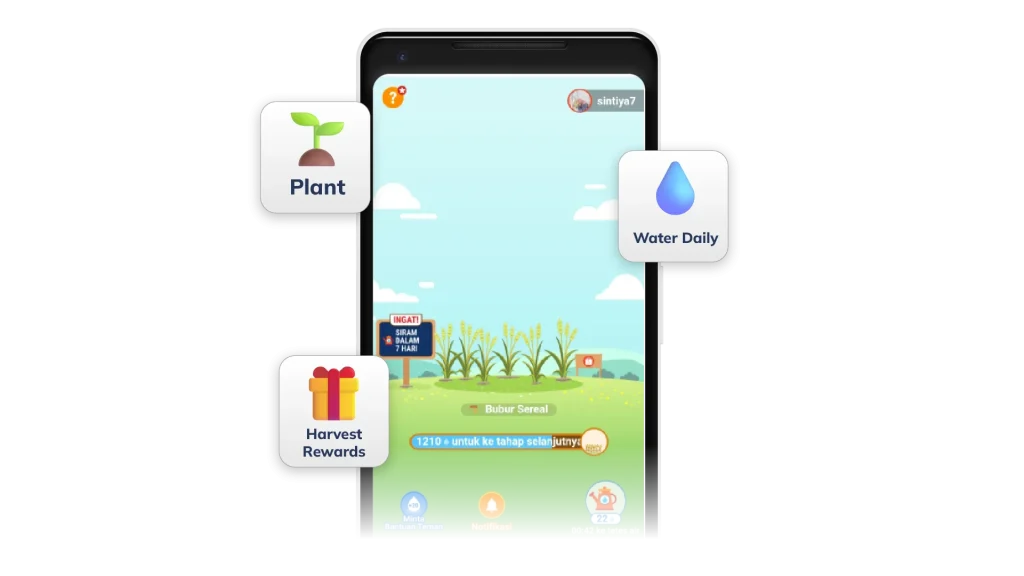
One of the most recognizable gamified features during Ramadhan is Shopee’s Shopee Tanam.
In this feature, users plant virtual crops inside the app and must return daily to water them. As the plants grow, users eventually harvest rewards such as vouchers or coins.
This mechanic creates a daily progression loop:
Plant → Water → Progress → Reward
Because progress requires daily participation, users are encouraged to open the app repeatedly.
This approach mirrors the progression mechanics commonly used in games to build habits and retention.
2. Tokopedia: Time-Limited Event Mechanics
Tokopedia
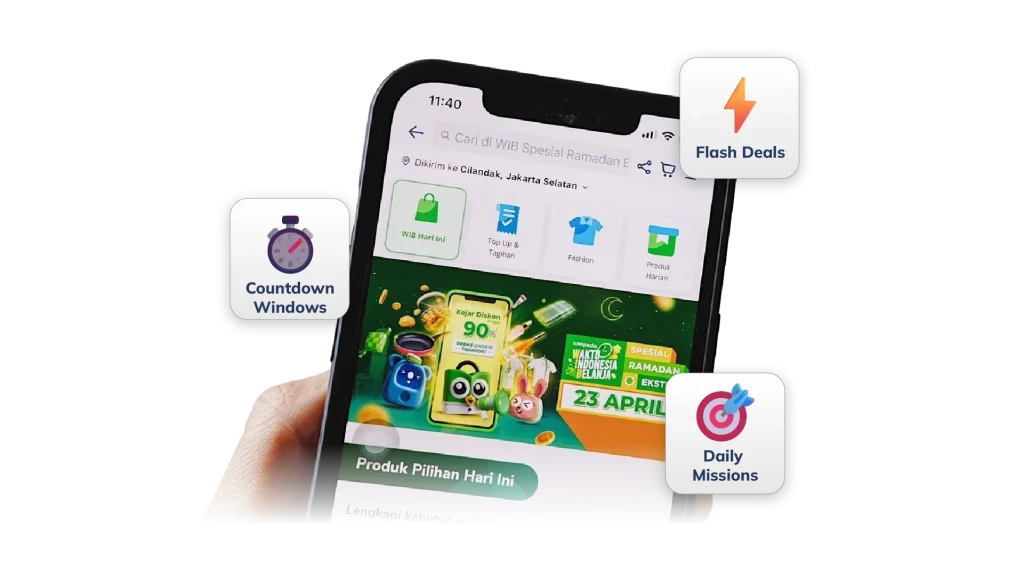
Tokopedia’s Waktu Indonesia Belanja (WIB) campaigns often intensify during Ramadhan.
These campaigns rely heavily on urgency-driven mechanics:
Flash deals
Countdown windows
Daily missions
Time-limited promotions
In gamification design, this is known as a time-limited event mechanic.
By creating short engagement windows, brands increase the likelihood that users return multiple times throughout the campaign period.
This technique is widely used in games to drive engagement spikes during seasonal events.
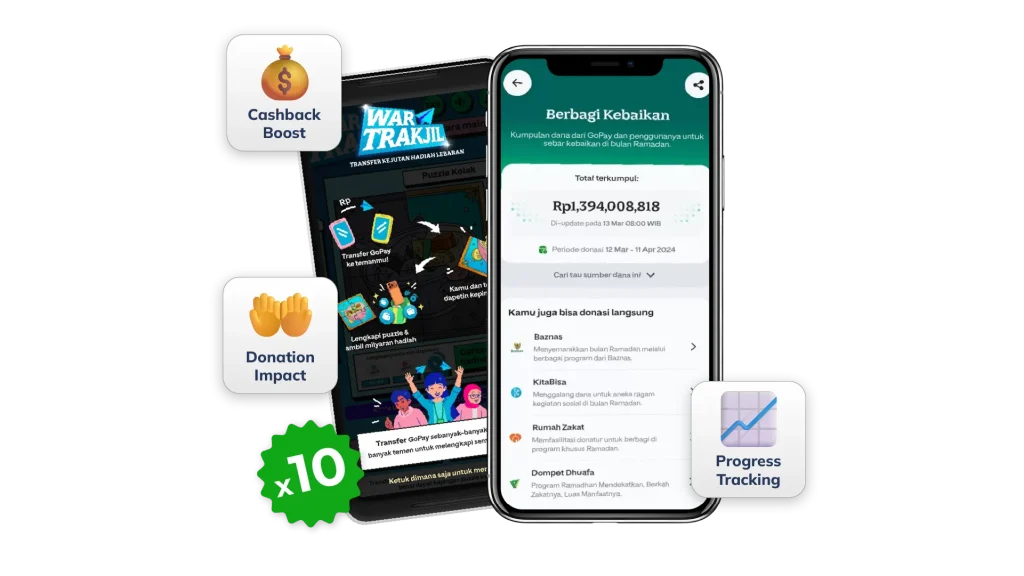
3. GoPay: Multiplier Reward Systems
GoPay
Ramadhan culturally emphasizes generosity and charitable actions.
GoPay aligns with this behavior by introducing cashback promotions and donation features during the season.
Users can experience:
Cashback bonuses
donation participation
transaction rewards
community impact tracking
From a gamification perspective, this represents a multiplier mechanic.
More participation leads to greater rewards, encouraging repeated actions.
This mirrors reward multipliers commonly seen in games, such as double XP events or bonus reward periods.
4. McDonald’s: Consumption Loop Mechanics
McDonald’s Indonesia
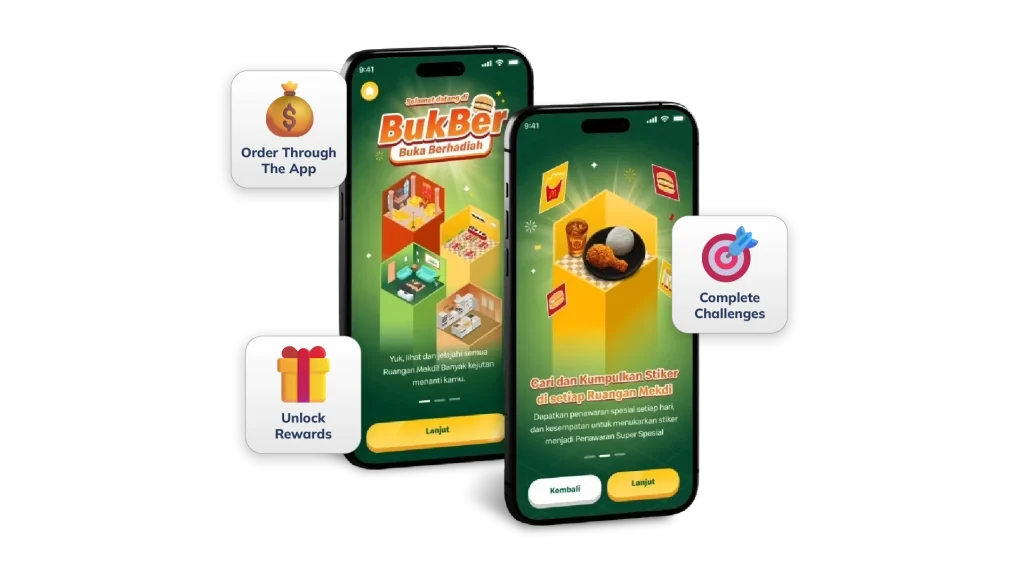
Another example can be seen in McDonald’s Ramadhan promotions through its mobile app.
These campaigns often include:
app-exclusive challenges
reward unlocks
digital vouchers
limited-time menu access
This structure forms a consumption loop:
Purchase → Reward → Return → Repeat
Gamification systems frequently rely on this loop to increase retention and repeat engagement.
In retail marketing, this approach transforms a simple purchase into a recurring interaction cycle.
The Core Gamification Framework Behind Ramadhan Campaigns
Across these examples, we can identify four core gamification mechanics that consistently appear in Ramadhan campaigns.
1. Fixed-Term Progression
Ramadhan’s limited 30-day period naturally encourages participation and completion.
2. Escalating Momentum
Engagement tends to intensify toward the final phase of the season.
3. Multiplier Incentives
Rewards and generosity are culturally amplified during Ramadhan.
4. Social Participation
Many Ramadhan activities are experienced collectively with families and communities.
These four elements form a powerful behavioral framework for marketing campaigns.
Why Gamification Works Better Than Discounts
Traditional promotions rely heavily on price incentives.
However, price-based campaigns often face several limitations:
short-term engagement
limited emotional connection
reduced brand differentiation
Gamification offers an alternative.
By introducing progression systems, interactive challenges, and reward mechanics, brands can create experiences that encourage active participation rather than passive consumption.
Instead of simply buying products, users interact with the brand through gameplay-like systems.
This can increase:
customer retention
repeat interactions
brand recall
product discovery
Designing Better Ramadhan Campaigns With Gamification
For brands planning Ramadhan campaigns, the key question is no longer how big the discount should be.
The better question is:
What behavior system are we designing?
Effective campaigns during Ramadhan often include elements such as:
daily participation mechanics
time-limited engagement windows
reward progression systems
community participation features
leaderboard or challenge elements
These mechanics transform marketing campaigns into experiences.
The Future of Ramadhan Marketing
Ramadhan is not just a seasonal marketing moment.
It is a structured behavioral ecosystem.
Brands that understand this can move beyond traditional promotions and build engagement systems that align with how people naturally behave during the season.
Because the most effective marketing strategies do not interrupt behavior.
They align with it.
If your brand is planning a Ramadhan campaign, consider designing it as an engagement system rather than just a promotional event.
Gamification can help transform seasonal campaigns into interactive experiences that drive stronger participation and long-term engagement.
The Authors
Junialdi Dwijaputra
Dias Setyanto
Related Articles
Result: Faster creation, broader access, and more efficient workflows.
Source: Canva Newsroom
- All Posts
- All-EN
- Education-EN
- News-EN
- Service Highlight-EN

It leverages your brain’s reward system, giving you quick wins and visual progress that boost your motivation to keep going.