



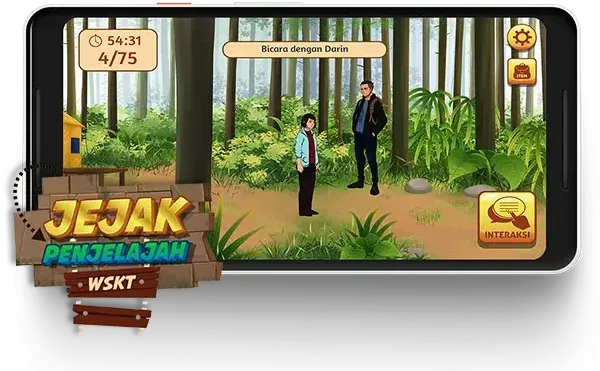
Waskita Karya, a state-owned construction company specializing in commercial and residential building contracts, faced a challenge in optimizing its recruitment process to identify and assess qualified applicants effectively. In the pursuit of seeking qualified individuals for their projects, Waskita recognized the need to enhance their entire assessment process, ensuring a comprehensive understanding of applicants’ potential.
Objective
The primary objective of utilizing gamification is to assess and evaluate the nature, quality, and abilities of individuals engaging with the game. The narrative guides players through decision-making scenarios, accompanied by mini-games and puzzles, contributing to a comprehensive evaluation of their behavioral tendencies and overall quality score.
Challenge
The challenge lies in creating an assessment tool that effectively captures and analyzes player decisions, translating them into meaningful insights into their behavioral responses to different scenarios presented within the game’s narrative.
Solution
To address this challenge, “Jejak Penjelajah WSKT” incorporates a diverse range of mini-games and puzzles tailored to assess four types of intelligence: Intellectual Quotient (IQ), Spiritual Quotient (SQ), Emotional Quotient (EQ), Adversity Quotient (AQ).
Each mini-game analyzes specific aspects, such as patterns, algorithms, qualitative reasoning, chapter storylines, emotional impact, and trial-and-error processes. This approach ensures a holistic evaluation of players’ abilities and skills.
Result
After conducting assessments through “Jejak Penjelajah WSKT,” several significant outcomes have been observed:
Behavioral Insights
The game successfully captures and analyzes player decisions, allowing for insights into their behavioral responses to different scenarios presented within the narrative.
Quality Score Determination
Through evaluating performance scores obtained in mini-games and puzzles, the game effectively generates a quality score, indicating the player’s abilities and skills demonstrated during gameplay.
Individualized Results
The diverse outcomes derived from the player’s decisions contribute to providing unique and tailored assessments for each individual, highlighting their strengths and areas for improvement.
Engagement and Interaction
The integration of storytelling, decision-making, and interactive puzzles has enhanced player engagement and immersion within the game, facilitating a comprehensive evaluation of their nature and abilities.
Data-Driven Evaluation
The collected data from players’ interactions and performances within the game serve as a valuable resource for detailed analysis and future enhancements of the assessment process.